
The satellite would provide a thrust to mobile communication through multi-beam coverage facility, the ISRO said.

'It is a blessing in disguise that they could find the glitch before the launch.' 'If this was not found, the entire mission would have been lost.'

Eminent rocket scientist S Somanath has been appointed as the chairman of the Indian Space Research Organisation as well as the space secretary, a personnel ministry order issued on Wednesday said.
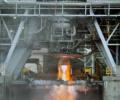
India's first indigenously designed and developed high-thrust cryogenic rocket engine generating a nominal thrust of 19 tonnes was successfully endurance hot-tested for 800 seconds.

An industrial house bred in old-school manufacturing values, Godrej & Boyce has displayed unusual agility to become a trusted builder of advanced weaponry, discovers Ajai Shukla.

There is a huge spurt in demand to launch smaller satellites, those as light as 1 kg, with a lifespan of two to three years. But there aren't enough rockets to carry these, reports T E Narasimhan
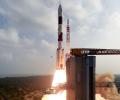
The Indian Space Research Organisation (ISRO) is all set to make its maiden commercial launch of 36 broadband communication satellites on board the space agency's heaviest rocket LVM3-M2, the countdown for which began early on Saturday at Sriharikota spaceport in Andhra Pradesh.

There appears to be uncertainty over availability of a lander from Russia even as the 'desi' rocket to launch the space odyssey would take time to become operational.

ISRO launched 12 Indian, 22 foreign satellites and successfully flight-tested India's first winged-body aerospace vehicle.
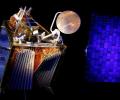
On Sunday, at 12.07 am in Sriharikota, off the coast of the Bay of Bengal, it was almost like an early Diwali, with the sky lit up by the launch of 36 OneWeb satellites. The Indian Space Research Organisation (Isro) did the launch on a 43.5-metre-tall Geosynchronous Satellite Launch Vehicle Mark III (GSLV Mk III) rocket. After the countdown, which started 24 hours in advance, once the mega screen marked the launch, a select group of invitees at the gallery cheered by applauding the feat.

The earth observation satellite would provide real-time images of the country and also be able to quickly monitor natural disasters.

Officials hint the visit could finally see a formal defence industrial road map being adopted by both nations.

On Sunday morning, in its mission to place an earth observation satellite and students satellite into the low earth orbit, the SSLV-D1/EOS-02 blasted off precisely at 9.18 am amid cloudy skies from the first launch pad at Satish Dhawan Space Centre in this spaceport.

Indian Space Research Organisation's (ISRO's) heaviest rocket LVM3 will launch British start-up OneWeb's 36 broadband satellites from the spaceport in Andhra Pradesh's Sriharikota on October 23, marking the launcher's entry into the global commercial launch service market.
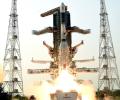
Over 32 missions -- satellites and rockets -- have been planned for the year.

GSLV-MK III, which uses a homegrown cryogenic engine, has to do at least two more launches before it begins commercial operations, report Raghu Krishnan and T E Narasimhan.

All progress in space should excite us and encourage us to be optimists about a better future for our planet and all of us, asserts Aakar Patel.
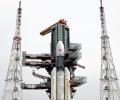
India's second moon mission Chandrayaan-2 is all set to be launched on board Indian Space Research Organisation's most powerful rocket GSLV-Mk0III-M1 from Satish Dhawan Space Centre in Shriharikota.

The 3,423 kg GSAT-29 carries Ka and Ku band high throughput transponders intended to meet the communication requirements of users, including in the North East and in Jammu and Kashmir.

The Rs 978 crore mission, which has been rescheduled for Monday after scientists corrected the glitch in the rocket, will be launched at 2.43 p.m from the second launchpad at Satish Dhawan Space Centre, over 100 km from Chennai.

Only three countries (United States, Russia and China) have successfully landed spacecraft on the airless lunar surface.

Four years after it broke many hearts, Indian Space Research Organisation's Chandrayaan is all set to soar towards the moon in its third expedition on Friday in an attempt to put the country in an elite club of nations that accomplished lunar missions with a soft landing.
The 2,268-kg GISAT-1 was originally slated to be launched from Sriharikota in Andhra Pradesh's Nellore district, about 100 kms north of Chennai, on March 5 last year but was postponed a day before the blast-off due to technical reasons.

Friday's mission is the fourth operational flight of LVM3 which aims to launch the Chandrayaan-3 spacecraft into a Geo Transfer Orbit.

The rocket is almost 49 meters high -- as much as a 17-floor building. It weighs 415 tons -- as much as the combined weight of 80 full grown elephants.
The space agency lines up GSLV-III and Chandrayan-II in 2017-18.

India's first exclusive defence satellite GSAT-7 was successfully launched by European space consortium Arianespace's Ariane 5 rocket from Kourou spaceport in French Guiana on Friday, giving a major push to the country's maritime security.

The mission life of the 2,250kg GSAT-7A, built by ISRO, is eight years. It will provide communication capability to users in Ku-band over the Indian region.
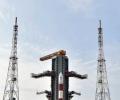
Here are some things you must know about this significant launch and why this satellite is a big deal for India.

ISRO's first mission in 2023 and SSLV's sequel saw a strange coincidence--it was launched at 9.18 am, the same time its predecessor lifted off from the Satish Dhawan Space Centre here on August 7, 2022 but could not deliver due to orbit anomaly and flight path deviation.

Swapnila said they saw the GSLV Mk-III rocket that will launch the mission into space. "It was so huge," she added.

With the launch of GSLV-MK III, slated for April, it will be able to cater to bigger satellites as well.

Except Pakistan, seven SAARC countries are a part of the project.

'ISRO is resilient enough to spring back and come with a solution quickly.'
India's second mission to the moon will be launched on Monday at 2.43 pm after its initial launch on July 15 was called off owing to a "technical glitch."

Indian Space Research Organisation will announce a revised launch date later.
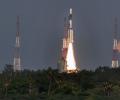
The satellite will enable a full range of services to neighbours including the areas of telecommunication, television, direct-to-home, VSATs, tele-education and tele-medicine.
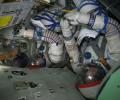
He also said it may be adopted for use in every stage of a rocket. He was speaking at the 16th convocation of SRM Institute of Science and Technology, near Chennai.
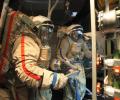
The Gaganyaan project has the objective of demonstrating human space flight capability to Low Earth Orbit with three crew members in orbit and safely recovering them after the mission.

The GSLV will put into orbit the INSAT-4CR, which carries 12 high-power Ku-band transponders for direct-to-home television services, video picture transmission and digital satellite news gathering.
